
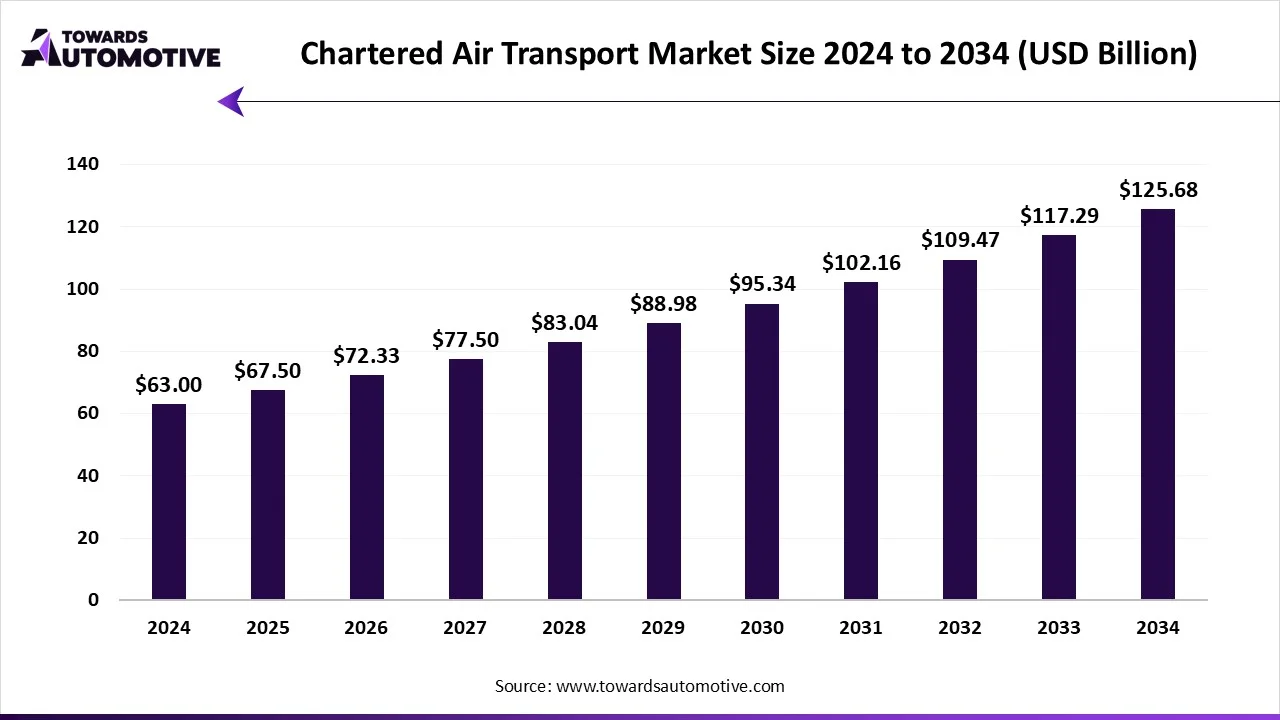
The global chartered air transport market is on a remarkable growth trajectory, projected to expand from USD 67.5 billion in 2025 to USD 125.68 billion by 2034, registering a CAGR of 7.15%. The rise in demand for flexible, private, and time-efficient travel options has been the key driver for this sector.
Unlike scheduled airlines, chartered air transport provides exclusive aircraft and crew on a non-scheduled basis. Services include ad-hoc charters, scheduled charter flights, ACMI/leasing, fractional ownership, air ambulance, and specialized missions. Both fixed-wing aircraft and rotary-wing helicopters cater to different consumer demands, ranging from business travel and luxury tourism to medical evacuations and governmental use.
Corporate executives, high-net-worth individuals (HNIs), and VIPs are the primary users of chartered flights. However, accessibility is expanding with subscription programs and per-seat models, making private aviation more attainable for a larger consumer base. Advancements in aircraft design, fuel efficiency, and the ability to operate from smaller regional airports are democratizing access further.
Download a Sample of Our Market Intelligence: https://www.towardsautomotive.com/download-sample/1837
Market Dynamics
Key Growth Drivers
-
Globalization of Business: Corporations demand faster connectivity across global markets to facilitate international trade and negotiations.
-
Luxury and Personalized Travel: A growing number of HNIs and VIPs seek exclusive, tailored travel experiences.
-
Emerging Access Models: Subscription-based and fractional ownership models make private aviation cost-effective for frequent flyers.
-
Technological Advancements: Next-generation aircraft feature enhanced fuel efficiency, comfort, and sustainability.
-
Medical & Specialized Missions: Increasing reliance on air ambulances and urgent chartered missions adds to market expansion.
Market Restraints
-
High Costs of Operations: Maintenance, fuel, and crew salaries limit affordability for mass adoption.
-
Regulatory Challenges: Air traffic regulations and safety standards vary globally, affecting operations.
-
Environmental Concerns: Growing scrutiny on carbon emissions necessitates investment in sustainable aviation fuel (SAF).
Market Opportunities
-
Sustainable Aviation: Development of electric aircraft and SAF adoption present long-term opportunities.
-
Emerging Economies: Rising income levels in China, India, and Southeast Asia create strong demand for regional charters.
-
Digital Booking Platforms: Online charter marketplaces and apps increase convenience and accessibility.
Market Insights 2025: Chartered Air Transport
The global chartered air transport market in 2025 presents a dynamic picture of growth, shaped by strong regional performances, evolving customer preferences, and innovative service models. The industry’s resilience is reflected in its ability to adapt to rising demand for time-efficient, flexible, and private travel solutions. As business and luxury travel accelerate globally, 2025 serves as a critical year that highlights the key market insights across regions, aircraft types, service categories, customer bases, flight ranges, and booking models.
North America: Market Leader with 40% Share
In 2025, North America dominated the global chartered air transport market with a 40% share, establishing itself as the undisputed leader. This strong performance can be attributed to three key factors: the region’s extensive fleet size, high concentration of wealthy consumers, and well-developed aviation infrastructure.
The United States, in particular, remains at the forefront, hosting the world’s largest number of private jets and charter operators. Major hubs such as New York, Los Angeles, and Miami cater to both business executives and affluent leisure travelers who value time efficiency and exclusivity. The region’s dense network of regional airports also gives charter operators an edge, offering customers convenient access to destinations not typically serviced by commercial airlines.
In addition to infrastructure and demand, North America is increasingly focusing on sustainable aviation initiatives. Investments in sustainable aviation fuels (SAF) and electric aircraft prototypes highlight the region’s commitment to reducing carbon emissions. This combination of wealth, infrastructure, and innovation ensures that North America continues to dominate the charter market landscape.
Asia-Pacific: Fastest-Growing Region
While North America leads in market share, Asia-Pacific is the fastest-growing region in 2025, fueled by rising wealth, new aviation hubs, and an increasing appetite for luxury travel. Countries like China and India are driving much of this growth.
China, home to a rapidly expanding population of high-net-worth individuals, has seen a surge in private jet demand, particularly for long-haul international routes connecting business centers such as Beijing, Shanghai, and Hong Kong. At the same time, the government’s focus on airport expansion and aviation modernization ensures that charter companies can tap into a growing infrastructure.
India, on the other hand, represents an emerging hotspot. With the rise of an upper-middle-class demographic and expanding corporate sectors, the demand for regional charters, executive travel, and even luxury event-related flights is increasing. The Indian government’s investment in regional airport connectivity programs further enhances opportunities for charter operators.
Tourism also plays a critical role in Asia-Pacific’s growth. Destinations such as the Maldives, Bali, and Thailand are seeing rising numbers of affluent tourists who prefer private aviation for its convenience and exclusivity. Combined with a young, aspirational consumer base, Asia-Pacific’s growth momentum positions it as the region to watch over the next decade.
Invest in Our Premium Strategic Solution: https://www.towardsautomotive.com/price/1837
Business Jets: The Leading Aircraft Type
The business jets segment captured 45% of the market share in 2025, making it the dominant aircraft type in chartered air transport. This dominance is largely due to the unmatched balance of speed, comfort, and flexibility offered by business jets.
Corporate executives and government officials rely heavily on business jets for regional and international travel. The ability to attend multiple meetings in different cities on the same day provides corporations with a clear productivity advantage. High-net-worth individuals also favor business jets for their luxury, privacy, and convenience.
Technological advancements have further strengthened the appeal of business jets. Modern designs offer improved fuel efficiency, extended range, and luxurious cabin interiors, making them a preferred option for both short-haul and intercontinental flights. The continued expansion of the global business community and increasing numbers of high-income earners are expected to sustain and accelerate the demand for business jets.
On-Demand/Ad-hoc Charters: The Preferred Service Type
Among service types, the on-demand/ad-hoc charter model dominated in 2025 with 38% market share. This model remains attractive due to its unparalleled flexibility, allowing customers to book flights as and when required without the burden of long-term commitments.
The on-demand model resonates particularly with business travelers and affluent individuals who value freedom of choice, personalized schedules, and the ability to select aircraft that best suit their needs. Whether it’s an urgent business trip or a last-minute leisure getaway, on-demand charters provide immediate solutions.
At the same time, the industry is witnessing the rise of fractional ownership and membership programs, which are expected to grow rapidly. These models allow frequent flyers to access private aviation at reduced costs compared to full ownership. While on-demand charters dominate today, the evolving service landscape promises more diverse options for consumers in the future.
Corporate/Business Users: Largest Customer Base
In terms of customer type, corporate and business users accounted for 33% of market share in 2025, maintaining their position as the largest customer segment. For businesses, the time-saving benefits of private aviation are a critical driver. Executives can avoid the delays and inefficiencies of commercial airlines, making charter flights an essential tool for productivity.
Moreover, corporate charters provide an additional layer of privacy and security, allowing companies to conduct confidential discussions while in transit. This is particularly important for industries where sensitive negotiations or strategic planning occur during travel.
While corporations dominate today, the HNIs and VIPs segment is growing at the fastest pace, fueled by increasing global wealth and a desire for exclusive, personalized travel experiences. Over time, the demand from HNIs is expected to significantly reshape the market landscape.
Short-Range Flights: Meeting Regional Demand
The short-range segment captured 37% of the total market in 2025, reflecting strong demand for regional and same-day travel. Short-range charters are especially popular among corporate clients who need to travel between nearby cities quickly and return the same day.
Short-range flights also appeal to leisure travelers seeking fast and convenient access to regional vacation destinations. For example, executives based in Europe frequently use short-range charters to reach Mediterranean resorts, while travelers in the U.S. prefer charters between cities like New York, Washington, and Boston.
From a cost perspective, short-range charters are more affordable compared to long-range options, making them accessible to a wider customer base. This affordability, combined with convenience, explains why short-range flights continue to dominate the chartered air transport market.
Hourly Flight-Hour Rate Model: Dominating the Booking Models
In 2025, the hourly/flight-hour rate booking model held a dominant 50% share of the market. The model’s simplicity and transparency make it particularly attractive to both corporate and individual clients.
Under this model, customers pay only for the actual flight time, ensuring predictable costs and flexible use. It is widely preferred by clients who want the freedom to charter aircraft when needed without long-term obligations. The model is also attractive to businesses that budget travel costs annually, as hourly billing provides financial clarity and control.
Meanwhile, subscription-based and per-seat booking models are gaining momentum. These models make private aviation more accessible by allowing customers to pay for individual seats rather than an entire aircraft. For frequent travelers, subscription programs also provide guaranteed access at lower costs. While hourly rates dominate today, subscription-based models are expected to reshape the market in the coming years.
Market Segmentation
By Aircraft Type
-
Business Jets (45% share) – Preferred for speed, comfort, and convenience in regional and international travel.
-
Turboprops and Light Aircraft – Popular for regional connectivity and smaller airports.
-
Rotary-Wing Aircraft (Helicopters) – Utilized in corporate transport, luxury leisure, and emergency services.
By Service Type
-
On-demand/Ad-hoc Charter (38% share) – Leading due to unmatched flexibility.
-
Fractional Ownership/Membership – Fastest-growing, offering affordability for frequent users.
By Customer Type
-
Corporate/Business (33% share) – Driven by time-sensitive international business needs.
-
HNIs/VIPs – Fastest-growing segment, motivated by luxury and exclusivity.
By Range
-
Short-range (37% share) – Dominant in regional connectivity.
-
Long/Ultra-Long Range – Fastest-growing due to demand for non-stop intercontinental travel.
By Booking Model
-
Hourly/Flight Hour Rate (50% share) – Simple, predictable pricing.
-
Per-seat/Subscription Programs – Fastest-growing, democratizing access to private aviation.
Regional Insights
North America – Market Leader
North America leads the global market with 40% share, powered by wealthy customers, a large fleet, and strong aviation infrastructure. The United States dominates within the region, boasting the largest number of charter companies and private jets.
Asia-Pacific – Fastest Growing Region
-
China: Largest APAC market, supported by wealth creation, luxury travel, and government investments in aviation.
-
India: A rapidly growing market driven by an expanding upper-middle class, luxury weddings, and growing airport infrastructure.
Europe
Steady growth is supported by luxury tourism hotspots, sustainable aviation initiatives, and cross-border corporate travel.
Competitive Landscape
The chartered air transport industry is highly competitive, with companies focusing on expanding fleets, offering flexible booking models, enhancing luxury services, and adopting fuel-efficient aircraft.
Top Companies
Gulfstream Aerospace
-
About: Founded in 1958, renowned for ultra-long-range business jets.
-
Products: Gulfstream G500, G600, G700, and G800.
-
Market Cap: Parent company General Dynamics – approx. USD 80 billion (2025).
Bombardier (Business Aircraft)
-
About: Established in 1942, Canada-based manufacturer of luxury business jets.
-
Products: Global 7500, Challenger 3500.
-
Market Cap: Approx. USD 6 billion (2025).
Dassault Aviation
-
About: French aerospace company, founded in 1929.
-
Products: Falcon 6X, Falcon 8X.
-
Market Cap: Approx. USD 15 billion (2025).
Embraer (Executive Jets)
-
About: Brazilian manufacturer, founded in 1969.
-
Products: Phenom 300E, Legacy 650E, Praetor 600.
-
Market Cap: Approx. USD 4.5 billion (2025).
Textron Aviation (Cessna & Beechcraft)
-
About: Founded in 1927, U.S.-based, leader in light and mid-size aircraft.
-
Products: Cessna Citation jets, Beechcraft King Air.
-
Market Cap: Parent Textron Inc. – approx. USD 20 billion (2025).
Airbus Corporate Jets (ACJ)
-
About: Established in 1997, subsidiary of Airbus, focused on private versions of commercial airliners.
-
Products: ACJ319neo, ACJ320neo, ACJ350.
-
Market Cap: Airbus SE – approx. USD 110 billion (2025).
Boeing Business Jets (BBJ)
-
About: Founded in 1996, offers VIP variants of Boeing aircraft.
-
Products: BBJ 737, BBJ 787 Dreamliner, BBJ 777X.
-
Market Cap: Boeing – approx. USD 130 billion (2025).
ATR
-
About: Joint venture of Airbus and Leonardo, founded in 1981.
-
Products: ATR 42, ATR 72 turboprops.
-
Market Cap: Privately held (under Airbus/Leonardo structure).
Pilatus Aircraft
-
About: Swiss manufacturer, founded in 1939.
-
Products: PC-12 turboprop, PC-24 light jet.
-
Market Cap: Privately owned (approx. valuation USD 4 billion).
Honda Aircraft Company
-
About: Subsidiary of Honda Motor Co., founded in 2006.
-
Products: HondaJet Elite II.
-
Market Cap: Parent Honda Motor – approx. USD 50 billion (2025).
Leonardo S.p.A.
-
About: Italian aerospace and defense company, founded in 1948.
-
Products: AW139, AW169, AW189 helicopters.
-
Market Cap: Approx. USD 12 billion (2025).
Robinson Helicopter Company
-
About: U.S.-based, established in 1973, specializes in light helicopters.
-
Products: R22, R44, R66.
-
Market Cap: Privately owned (approx. valuation USD 500 million).
Recent Developments
-
January 2025: FlyJetr launched luxury jet charter services with access to 15,000 jets globally.
-
January 2025: CN Logistics launched Ezhou–Milan charter flights, enhancing international logistics.
-
April 2025: Air Charter Service partnered with Silverstone to expand premium travel options.
-
June 2025: PrivateJet.com launched a new charter company, increasing competition and accessibility.
-
September 2025: JSX sought approval for regional charter flights from Santa Monica Airport.
FAQs
Q1. What is the projected size of the chartered air transport market by 2034?
The market is expected to reach USD 125.68 billion by 2034, growing from USD 67.5 billion in 2025 at a CAGR of 7.15%.
Q2. Which region leads the chartered air transport market?
North America leads with 40% market share, driven by strong infrastructure, a wealthy customer base, and a large fleet size.
Q3. Which aircraft type dominates the market?
The business jets segment dominates with 45% share, as it balances speed, flexibility, and luxury.
Q4. Who are the top players in the market?
Key players include Gulfstream, Bombardier, Dassault Aviation, Embraer, Textron, Airbus Corporate Jets, Boeing Business Jets, Pilatus, and Leonardo.
Q5. What trends will shape the future of the market?
Key trends include subscription models, sustainable aviation initiatives, digital booking platforms, and expansion in Asia-Pacific markets.
Source : https://www.towardsautomotive.com/insights/chartered-air-transport-market-sizing
Access our exclusive, data-rich dashboard dedicated to the respective market built specifically for decision-makers, strategists, and industry leaders. The dashboard features comprehensive statistical data, segment-wise market breakdowns, regional performance shares, detailed company profiles, annual updates, and much more. From market sizing to competitive intelligence, this powerful tool is one-stop solution to your gateway.
Access Now: https://www.towardsautomotive.com/contact-us
Become a Valued Research Partner with Us – Schedule a meeting: https://www.towardsautomotive.com/schedule-meeting
Request a Custom Case Study Built Around Your Goals: sales@towardsautomotive.com
About Us
Towards Automotive is a leading research and consulting firm specializing in the global automotive industry. We deliver actionable insights across key segments such as electric vehicles (EVs), autonomous driving, connected cars, automotive software, aftermarket services, and more. Our expert team supports both global enterprises and start-ups with tailored research on market trends, technology, and consumer behavior. With a focus on accuracy and innovation, we empower clients to make informed decisions and stay competitive in a rapidly evolving landscape.
Stay Connected with Towards Automotive:
- Find us on Social Platforms: LinkedIn | Twitter | Instagram
- Subscribe to Our Newsletter: Towards AutoTech
- Read Our Printed Chronicle: Automotive Web Wire
- Visit Towards Automotive for In-depth Market Insights: Towards Automotive
- APAC: +91 9356 9282 04 | Europe: +44 778 256 0738 | North America: +1 8044 4193 44
Get ahead of the trends – follow us for exclusive insights and industry updates: